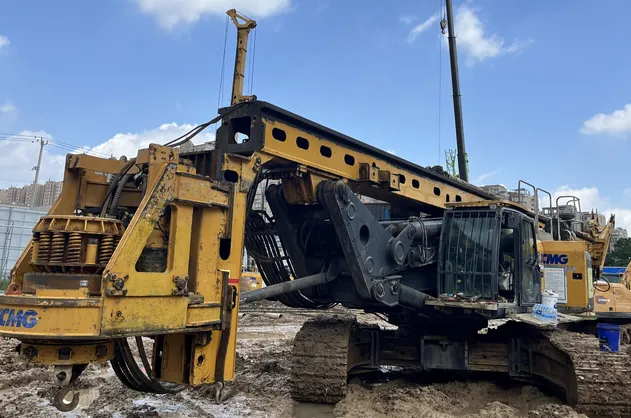
Matching Rigs, Kelly Bars, and Tools to Real Ground—From Loose Sands to Dense Sandstone
Contractors don’t choose a rotary drilling rig in a vacuum. They choose a rig–Kelly bar–tooling system that must drill specific piles in a specific ground profile under real constraints: weather, crew skills, supply of consumables, and delivery dates. This guide distills a practical selection method using the “loose/medium/dense sand-rock” spectrum as a backbone. It combines the field patterns summarized in the reference table you shared (advance rate and bit life by density class, with typical failure modes), and it connects those patterns with equipment options we supply at JM (Xuzhou Jiuman Machinery)—including interlocking Kelly bars, friction Kelly bars, and refurbished rotary drilling rigs compatible with XCMG, SANY, ZOOMLION, and BAUER.
Where we cite exact model capabilities (e.g., torque classes), we reference the open specs on our site for clarity, not to push a single brand or size. Examples include XR150D, XR280E, XR360E, XR400 and others that contractors frequently pair with JM Kelly bars.
1) Start from the ground, not the catalogue
The table you provided captures a reality every piling manager knows:
Loose sand-rock: faster meters per hour, longer tool life (typical ranges like 4–6 m/h and 120–150 h per bit), but wall instability and bucket choking appear quickly if the crew outruns support.
Medium density: progress slows (about 1.5–3 m/h), cutting tooth wear rises, and power head heat becomes the limiter if slurry and bite depth aren’t balanced.
Dense sand-rock: advance can fall to sub-meter per hour, and the risk shifts to slip, torsional shocks, and fatigue at the bar and tool joints, especially with aggressive crowd.
Those three rows tell you what to manage: stability, heat/wear, and shock/fatigue—not just “buy a bigger machine.” The best choices of rig class, Kelly bar type, and tooling are the ones that reduce those three sources of loss on your site.
2) Map ground classes to rig torque windows and Kelly bar types
Think in windows, not single numbers:
Loose sands / sand-fill with lenses
Rig window: small–medium torque rigs excel; XR150-class is common in urban, mid-depth bored piles.
Kelly bar: friction Kelly bar is often enough—lighter, simpler, and faster to telescope in clean sands.
When to step up: if the profile includes occasional cemented layers or gravel shoulders, move to interlocking for secure torque transfer on those passes.
Medium density sands and sandy mudstone
Rig window: mid-torque rigs such as XR280E (≈300 kN·m class), balanced crowd and rotary speed; a good “all-rounder” that tolerates stickier soils.
Kelly bar: interlocking preferred for reliable lock-up under torque ramps, with wear protection on guides and key strips.
Dense sand-rock / weakly cemented sandstone
Rig window: high-torque machines—XR360E/ XR400 class—provide the torque and crowd to keep bite depth while avoiding constant stalls.
Kelly bar: interlocking is the standard; friction bars will lose efficiency and may slip under shock.
JM manufactures JS-series interlocking Kelly bars (e.g., JS377, JS406, JS419, JS508, JS559, with stage/length variants) and MZ-series friction bars; each can be tailored to the crowd/torque envelope of the chosen rig and your target pile geometry.
3) Convert the table’s “loss patterns” into equipment choices and operating tactics
A. Loose sands — control the flow, not just the speed
Problems to prevent: wall collapse and bucket choking.
Choices that help:
Rig: a mid-speed rotary with enough torque headroom to keep RPM stable while the operator feathers crowd during slugs of loose material (XR150-class is sufficient on most urban piles).
Kelly bar: friction bar for speed and simplicity; or a lightweight interlocking if the job frequently hits thin cemented horizons.
Tools: auger + cleanout bucket with generous openings; maintain sharp lips to avoid forcing RPM for bite.
Operating habits: short, regular clean cycles; conservative RPM in the first meters to seat the hole; polymer/slurry only as needed to bind fines. The aim is to keep the meter rhythm without triggering the instability that wipes out the hour you just gained.
B. Medium density — fight heat and wear, not time
Problems to prevent: cutting tooth wear; power-head heat.
Choices that help:
Rig: XR280E-class gives torque stability at moderate RPM so you don’t chase production with speed that only generates heat.
Kelly bar: interlocking with pressure plates that provide crisp engagement at each stage; specify wear plates on outer sections and tuned hardness for key strips. JM’s JS-series is engineered exactly for this torque/crowd regime.
Tools: stepped or conical bits that shed material; manage bite depth so cuttings exit without recirculating.
Operating habits: instrument the telescoping feel—any mid-stroke “stick-slip” is a sign to inspect pressure-plate contact or key-strip wear; reduce RPM and increase crowd slightly to keep specific energy in a productive band rather than heating teeth.
C. Dense sand-rock — respect shock and fatigue
Problems to prevent: drilling slip; torsional shocks; fatigue at bar/tool interfaces.
Choices that help:
Rig: XR360E/ XR400 level torque with enough crowd to hold bite without hammering; this class delivers the reserves you need when the hole narrows and friction rises.
Kelly bar: interlocking with robust lock geometry and straightness controls so the bar transmits torque without whipping. JM’s manufacturing line uses large-scale processing to control concentricity before welding and stages every bar on a full-stroke test stand.
Tools: core barrel, rock bucket, or heavy-duty auger as dictated by UCS.
Operating habits: treat shock as the enemy—manage torque ramps; check lock depth and pressure-plate preload; don’t chase production with sudden crowd pulses that only drive micro-slip and heat.

5) A quick productivity model you can test on site
Use the table’s density classes as the outer loop for planning:
In loose zones, target a steady rhythm with short clean cycles and conservative RPM; check wall stability frequently.
In medium zones, stop chasing meters—focus on tooth condition, cooling, and lock feel; predictable meters beat jittery bursts.
In dense zones, lower the rate goal; increase inspection frequency on the Kelly bar outer section and pressure-plate interfaces. Most “mysterious” downtime in hard ground is lock micro-slip and fatigue, not “lack of torque.”
Tie those behaviors to your rig torque window (XR150/280/360/400 classes) and bar choice (friction vs interlocking). If you maintain clean lock engagement and a smooth telescope, the meters per hour will follow—because your tool stays cutting instead of fighting friction and shock.
6) Case-style snapshots from JM projects (what this looks like in practice)
Southeast Asia (urban mixed ground): JS377-4×6 and JS377-4×8 interlocking Kelly bars paired with refurbished XR240E/XR360E rigs; focus on wear protection and crisp lock-up, plus spares staged locally.
Malaysia (dense sand-rock): JS406-4×15 with a high-torque rig; the outer section and pressure plates proved decisive—once contact and alignment were restored, lock slip disappeared and cycle time stabilized.
Export operations: four-layer packaging and steel frames let receiving yards lift directly from trucks without re-rigging, protecting coatings and lock faces through humid port layovers.
These are not “perfect ground” stories; they are typical jobs where the system choice mattered more than any single line item.
7) Why JM: manufacturing depth + service discipline
JM is a precision Kelly bar manufacturer with a large inventory of fully inspected used rotary drilling rigs. We operate from a modern 10,000 m² base and recently opened an additional 2,000 m² facility to expand Kelly bar production and refurbishment throughput—so when you need a customized Kelly bar or a used drilling rig on a deadline, we can load the ship, not just promise it.
Beyond steel, our Comprehensive Support System covers technical selection, around-the-clock after-sales response, and parts logistics. That’s why the most common feedback we get from site managers is not about paint or photos—it’s “the bar arrived clean, locked cleanly, and drilled on day one.”
8) Selection checklist (short, field-ready)
Define the density class per your logs; pick the rig torque window accordingly (XR150/280/360/400 classes for light/medium/heavy work).
Choose the Kelly bar: friction for clean sands and speed; interlocking for mixed or dense profiles. Elevate wear protection for sandy slurries.
Protect productivity: package with spares (pressure plates, key strips, retaining rings, drive adapter) and the four-layer wrap + steel frames so the gear arrives ready to work.
Inspect what matters: lock engagement depth, pressure-plate contact, key-strip wear, and telescope smoothness—especially when meters per hour drop without a clear cause.
Talk to us
Send us your rig model, pile diameter/depth, ground notes, and delivery window. We’ll reply with a one-page plan—rig class, interlocking/friction Kelly bar, spares, and a shipping route via Shanghai/Lianyungang/Qingdao that matches your dates. Our job is not to “sell a bar.” Our job is to deliver a complete drilling system that drills the piles you actually have.
Contact JM
Oversea Bussiness Manager | zhenghan.zhang@jmachglobal.com
WhatsApp: +86 188-5216-7087
Email: beverly.liu@jmachglobal.com; wayne.wang@jmachglobal.com; gloria.chong@jmachglobal.com